Mosquitoes abound – RAF Swannington

This airfield forms another in a short trail through this part of north Norfolk. An area littered with the remnants of war and aviation history.  As we continue south through the narrow lanes of the Norfolk countryside, we find the almost forgotten airfield at Swannington.

RAF Swannington

Swannington was one of the last airfields to be opened during the Second World War, hence very few units were permanently based here. This considered, an appreciable amount of it remains visible even today.

Also known as Haveringland, construction was started as early as 1942, but it didn’t actually open until 1944. It utilised much of the forests of nearby Haveringland Hall along with large parts of its estate. The hall itself, a rather large and grand building, was blown up at the end of the war following requisition damage and then being classed as ‘surplus to requirements’ by the MOD!

Once the forest area had been removed, work could begin, and a number of accommodation sites were erected. Haveringland Hall itself became the Officers mess, with various accommodation sites constructed all around it, all located to the east of the airfield. In 1944 there were 154 Officers (of both RAF and WAAF ranks) along with 1239 other ranks stationed here although accommodation was provided for around 2,500.
RAF Swannington

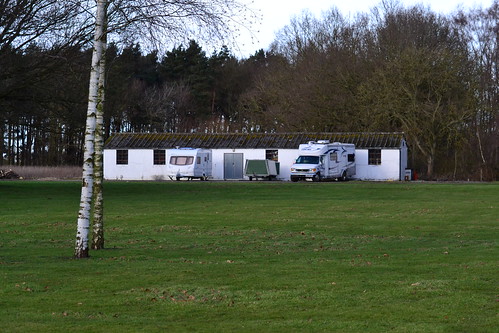
Former Sergeants Mess in use Today

Designated a class ‘A’ airfield, Swannington would have two T2 hangars and one B1, three runways (1 x 2000 yds and 2 x 1,400 yds) and 36 loop style hardstands.

100 Group became the immediate owners of Swannington and instantly placed two squadrons of de Havilland’s Mosquito at the base – No. 85 and 157 Squadrons. 100 Group were formed in November 1943 to investigate and oppose the electronic warfare operations being conducted by the Luftwaffe. To counter this threat, a number of airfields in this area were utilised, Swannington being one of them.

Using a range of new devises and tactics, 100 Group operated a range of different aircraft, predominately the heavier bombers: B-24s, Lancasters, B-17s, Halifaxes, Wellingtons along with the smaller and more agile, Mosquito.

On May 1st 1944, following a successful tour at West Malling*1 , the first Mosquito XVIIs of 85 Squadron arrived at Swannington.

Having a history that extended back to the First World War, 85 Sqn had been in France to support the B.E.F then, re-equipped, they participated in the opening skirmishes of the Battle of Britain. After taking on a new role as a night fighter squadron and moving to Yorkshire, they transferred to 100 group with their move to Swannington. Here they began supporting bombing missions, seeking out enemy night fighters before they attacked the bombers and then loitering over their airfields as they returned.

The Mosquitoes had proven so successful in all operations that 85 Sqn were moved back to West Malling for a short period to combat the increasing threat from the V-1 ‘Doodlebugs’. Their stay in Kent ended in the following August, at which point they returned to Swannington upgrading to the Mosquito XXX before moving off again, to RAF Castle Camps.

157 Squadron joined 85 at Swannington on May 7th 1944 with the Mosquito XIX, later upgrading to the NF.30 with its superchargers and a new radar. 157 had been the first squadron to receive the NF.IIs earlier in March 1942 with the delivery of both W4087 and W4098*2 .

157 Sqn’s arrival would not be the best. Three days after their arrival, Flight Lieutenants Tweedale and Cunningham would take off for an Airborne Interception (AI) training sortie in their Mosquito XVII. On their return, the aircraft would crash, losing its starboard undercarriage, and whilst neither officer was injured, it would be the first ‘casualty’ of 157 Squadron whilst based at Swannington. A very successful fighting unit, they would not be immune from further incidents, some to the embarrassment of their crews.

Whilst on patrol on November 21st 1944, Mosquito MM629 ‘RS-Y’ piloted by Flying Officers A Mackinnon and G Waddell, were shot down in error by another Mosquito of the same squadron, who believed them to be a Ju 88! Both crew members parachuted safely into enemy territory but managed to evade capture returning home within 12 hours.
RAF Swannington

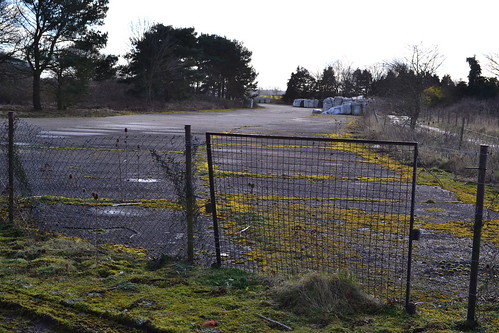
Portions of concrete remain in the Technical Area.

157 Sqn would also transfer with 85 Sqn to West Malling, undertaking ‘anti-diver’ or ‘Doodlebug’ sorties; operations that saw 157 Sqn claim a total of 36.5 flying bombs, whilst 85 claimed some 18.

157 Sqn then returned to Swannington with 85 Sqn at the end of August 1944 and as with 85 Sqn, they upgraded to the MK XXX Mosquito. They, unlike 85 Sqn however, remained at Swannington until disbandment on 16th August 1945. By the end of operations at Swannington, both 85 Sqn and 157 Sqn had completed a touch under 2000 sorties between them, with 108 enemy aircraft destroyed and 19 damaged.

Toward the end of 1944 and early 1945, four other fighter squadrons would visit Swannington. 229 and 451 (Australian) Squadrons came first in the November of 1944; in a move initiated by poor weather, they would come from nearby waterlogged Matlask. 229 brought Spitfire IXs which within a month they would replace with LF XVIEs. This was followed by a swift departure to nearby Coltishall where they were disbanded and renumbered 603 (Auxiliary) Sqn in the following January.

It was a similar story for both 453 (Australian) Sqn with their Spitfire LF XVI, and 602 Sqn with their Spitfire XVI, both swinging like a pendulum between Matlask and Swannington and Swannington and Coltishall. 453 Sqn then transferred to Kent and eventually the continent whilst 602 Sqn followed 229 to Coltishall where they were disbanded on May 15th 1945. These late model Spitfires were now escorting daylight bombing raids such was the strength and superiority of the Allied Air Force over Europe.
RAF Swannington

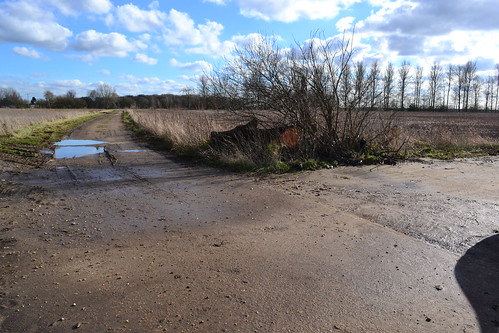
Portions of the Perimeter track remain, some of it in full width.

These four squadrons, 602, 229, 453 and 451, were to join forces with 124 and 303 to tackle the new V-2 rocket, strafing and bombing the launch and control sites. It was on the 14th February 1945, that 602 Sqn pilot Sgt. T “Cupid” Love fired upon a rising V-2, the first (and only) record of any such incident occurring. An account of the event appears in Raymond Baxter’s log, and he explains how it was fortunate that the shots missed, for had he hit the rocket, it would no doubt have exploded ending the lives of himself and his fellow crews.

As the war came to a close and German forces were thought to be amassing troops at Kiel for a final assault on Norway, Mosquitoes from 157 Sqn were sent along with those from 8 Group to attack airfields in the area. These were to be some of the last attacks carried out by RAF aircraft in the European Theatre.

Their final departures signalled the end of operational duties for Swannington. The site was used for storage of surplus materials, mothballed Mosquitoes and numerous Merlin Engines until the RAF finally pulled out in 1947. Future plans for an upgrade to the airfield were abandoned, and the site was then sold off, it has since become a mix of agriculture and forestry.

DSC_0220

Swannington’s Stand By Set House is used for storage.

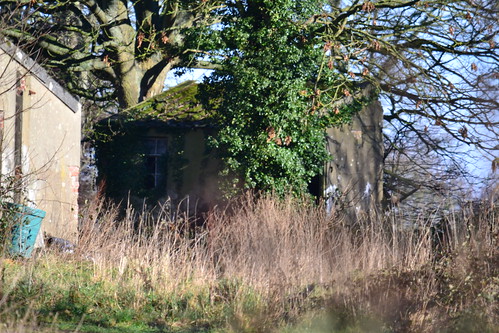
The majority of Swannington airfield is best seen from the eastern side. Approaching from the north, you first come across the former technical site that marks the top right corner of the site. Turn right here and you will see the location of one of the T2s, a farm building now stands here and behind it the location of the tower and a small number of ancillary buildings. These are today shrouded in trees and large bushes, which prevents any real sighting of them. Sadly the current condition, which is believed to be quite poor, is difficult to verify from this point on the roadside. Large portions of concrete denote the perimeter track and access routes to the technical area. Across the road from here, other buildings do still remain and are easily seen from the roadside. A small portion of the north-east / south-west runway also remains here, virtually full in its width.

Turning back on yourself, turn right and drive past the technical area to your right. Poultry sheds and farm buildings now stand here, but the shape of the hardstands are easily recognisable. On your left are more concrete structures and piles of rubble from former buildings. After a sort distance you arrive at the perimeter track, this crosses the road and is full width at this junction. A gate to your left allows access to the distant church, and by driving along here you traverse the actual perimeter where many Mosquitoes would  have moved on those night missions in 1944/45. The distant round-towered Church was so close to the perimeter that aircraft were often parked next to  the church yard, a rather eerie and stark reminder to those crews boarding the aircraft at this point. Stopping at the church the enormous size of the track can again be seen,  virtually full in its width, photos exist of a Mosquito also standing here in this very same position.

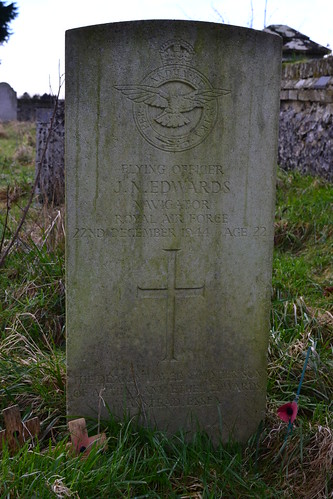
Outside this church, is a memorial dedicated by the ‘Airfields of Britain Conservation Trust’, the only ‘official’ memorial on the site. The church itself is locked, but two graves within the church yard and a bench dedicated to two members of the same family can be found here. The bench, dedicated to Lt. Cdr. M. Auckland and Flt. Lt. W. Auckland, both Harrier Pilots stands near the gate, whilst the older graves, F.O J. Edwards (Navigator) and Corporal C. Mace, can be found behind the church.

Flying Officer Edwards (s/n) 172240) was killed when his Mosquito TA392 ‘RS-K’ developed trouble whilst returning from an intruder mission. The aircraft crashed close to the airfield and both he and his pilot, Flt. Lt. W. Taylor, lost their lives. *3

Before returning, look across to the north to the small wooded area and you will see the Squash courts, standing in  what was the Haveringland Hall estate. Now return back to the road, and turn left, follow the road south. You will cross, a short distance away, the remains of the east-west runway, followed shortly by the returning perimeter track. Carry on to Clay Lane, and turn right. To your left is a small farm and a track that leads away over private land. This is the entrance to the bomb store, it circles round and rejoins the road further along, both now narrow and restricted to farm traffic only.
RAF Swannington

The Grave of F.O. J Edwards, Killed 22nd December 1944, age 22.

From here it is best to retrace your tracks, go back along Clay Lane, turn left and head north. On your right is a turn into the Haveringland Hall Holiday Park. A number of buildings remain here, the squash court, former sergeants mess and standby set house and most in good condition. The woods around here also contain many derelict remains and foundations of former structures. Some visible others shrouded by growth, many are too dangerous to explore.

Swannington had a short life, and many of the crews that passed though here went on to achieve great things. Swannington though wasn’t without its drama. Because of the nature of the operations carried out from here, losses were incurred, many fatal. The later part of 1944 saw a particularly high number of accidents and crew losses, many of these young men never being found.

The remaining buildings at Swannington stand as a silent reminder of the activities of 100 Group. Along with the brave Mosquito and Spitfire crews are all those who fought a long and hard battle against Hitler and his terror weapons. Whilst the Griffons and Merlins have gone, their memories have not.

Sources and further reading.

*1 85 Squadron was previously commanded by Wing Commander ‘Cats Eyes’ Cunningham, who became famous for downing 20 enemy aircraft during hostilities. He later went on to be a test Pilot for de Havilland, testing the DH Comet – the worlds first jet airliner. He received a number of awards and achieved a number of aviation firsts, He died in 2002.

*2 de Havilland Mosquito, An Illustrated History Vol 2, Ian Thirsk, Crecy Publications.

**3RAF Bomber Command Losses of the Second World War, W.R. Chorley, Midland.

Spitfire Dive-Bombers versus the V-2, Volume 2, Bill Simpson, Pen and Sword Books, has a good account of the V-2 war by the RAF Squadrons.

Britain’s Airfields 1944

By the end of the Second World War, there were a substantial number of airfields covering the UK, mainly used by the Royal Air Force, the United States Army Air Force, the Royal Navy and all their associated branches; they were handed back to the RAF at the end of the war as the various forces were pulled out. Some were used as POW or repatriation camps, some were used to store surplus aircraft, vehicles or ordinance; many were put into care and maintenance whilst the RAF decided their ultimate fate.

Thankfully a few have lasted as airfields and are even fulfilling that role today, sadly though, many were dug up, their runways used for hardcore, the buildings demolished and the events that occurred there reserved for the history books.

The scale and pace of development was massive. The size of these sites bigger than many of the villages they took their names from, the populations larger than many towns of the time. Architecturally they changed the landscape dramatically.

Today as they dwindle away, many are mere names, locals have little knowledge of their existence, memorials are being forgotten, and life is moving on.

As a little reminder of those times and to put the scale of development into perspective, here are two maps held by the British Library that show the main Royal Air Force and Royal Navy airfields as of 31st December 1944.

The two maps, divide the UK and show not only the airfields but satellites as well. They also show Royal Air Force and Royal Navy Water Airfields, and Royal Air Force Moorings. There are a number of sites not included on the map such as relief landing grounds, and training schools, but they do give an indication of the number of airfields that covered the UK by the end of the war.

These are both low resolution pictures, and copyright is held by the British Library who have given permission for them to be reproduced here.

Security Released Airfields in the United Kingdom (Sheet 1)
Security Released Airfields in the United Kingdom (Sheet 2)

© The British Library, Maps MOD GSGS Misc. 505 (sheet 1 and Sheet 2)

RAF Matlask, a Windy Corner of Norfolk with Hurricanes, Whirlwinds and Typhoons

In this, the 34th trail, we go back to the northern area of Norfolk, not far from the North Sea coast, and then head south. We end up near to RAF Attlebridge found in Trail 7, west of the city of Norwich.

Our first stop was a quite unassuming airfield, but one that played an important role during the Second World War. British readers will remember the distinct voice of one Raymond Baxter OBE,  the voice behind so many thrilling air show commentaries, the TV programme ‘Tomorrow’s World‘ and a wide range of outside commentaries that brought the wonders of science and technology into our homes. Baxter himself served in 602 Sqn RAF, and was stationed at the airfield in the latter stages of the war.  We are of course at RAF Matlask.

RAF Matlask (Station 178)

Documented on airfield site plans and other RAF Documents as  Matlask, as opposed to Matlaske the name of the village, it was a large grassed airfield hidden well into the Norfolk countryside.

The village of Matlaske separates the main airfield from the  four airmen sites and sewage disposal site, which were widely spread away to the north; only site 2 (communal and WAAF area) and site 7 (Sick Quarters), were located in the village itself.

RAF Matlaske

One of the few remaining buildings at Matlask. This being the former Site 3.

Accommodation was substantial, even taking over the large and rather grand Barningham Hall for the Officer’s Mess. The current building dates back to 1612 and stands in 150 Hectares of garden, park and lakes, a rather ‘up market’ dwelling, that is closed off to public access.

Other accommodation included a range of the usual huts, ‘Nissen’ and ‘Laing’ being the most prominent, with brick and timber featuring most.

The airfield itself stands to the south of the village, with the main entrance way off to the western side. A guard hut would have marked the main gate where a number of brick buildings would have been used for storage, technical activities, fuel storage and the like. A small road took you onto the concrete perimeter track that led all the way round the site. Dispersal was provided by 21 concrete hardstands, although a further 21 temporary hardstands were planned. One single T2 hangar was located  next to the technical area, with a further 5 Blister hangers (design 12512/41) spread around the perimeter. Aircraft dispersal was also provided by the standard 6 Type B protected dispersal pens, (7151/41) with built-in air raid shelters; each shelter having a crew entrance and emergency exit. Matlask initially had one watch tower to the north of the site next to the technical area. This was later modified to a two storey design and then a further example was built slightly to the south, this being of the more common two storey ‘standard’. wartime design (343/43).

Matlask although tucked away in the Norfolk countryside would not be devoid of activity. Some 22 RAF squadrons, an Air Sea Rescue unit and an American Fighter Group would all use it at some point.

Designed initially as a satellite for Coltishall, it was dogged with drainage problems, and surprisingly never seem to warrant any form of hard runway. It was opened in 1940 as part of 12 group, destined for fighter defence of the Midlands.

In 1937, 72 Sqn (RAF) was reformed. they moved around a variety of bases eventually ending up at Matlask’s parent base, RAF Coltishall. When Coltishall was attacked in late October 1940, it was decided to move the Spitfire squadron to Matlask for protection. This merely brought the war to Matlask for on the 29th, five Dorniers attacked the airfield, inflicting damage on several dispersed aircraft and injuring a number of personnel.

DSC_0149

The village sign in Matlaske village.

After this attack, the first of two, the Spitfires would leave and Matlask would revert back to a satellite having no permanent residents of its own. This situation continued until May/June 1941, when Spitfires IIbs would arrive also from RAF Coltishall (Trail 7) . 222 Sqn (RAF) only stayed until the following July, moving south to the large fighter base at RAF Manston, in Kent.

This would then set the tone for Matlask, a large number of short stays, most for no more than a month or so. But whilst their stays were short, the diversity of aircraft they used was not. Spitfire Is, IIbs, IX, XVI, Hurricane II, Airacobra I, Walrus, Lysanders, Westland Whirlwind, Typhoon Ia and Ib, P-47 ‘Thunderbolts’, Miles Master, Martinets, Hawker’s Henley, Tempest Vs and Mustang IIIs would all grace the skies over this region of Norfolk.

Perhaps one of the more notable examples to fly here, was the American Airacobra. 601 Sqn (RAF) moved from RAF Manston to Matlask at the end of June 1941, bringing Hurricanes with them. These were replaced by the distinctive tricycle undercarriaged P-39 ‘Airacobra‘ a short time after. The first auxiliary squadron, 601 was known as the “Millionaires’ Squadron” and said to have been created by Lord Grosvenor at the gentlemen’s club “White’s“. Membership was initially very restricted, and boasted a unique initiation into the ‘club’. Whilst a determined and very professional unit in the air, they acquired a reputation for flamboyance and bravado on the ground.

In looking for a new fighter, the RAF turned to the Americans. The Airacobra was trialled and whilst found to have a number of advantages over its adversaries, it was considered too poor at heights over 15,000ft. Used in only a small number of raids it was deemed inadequate and soon replaced, with many supplied models being sent on to Russia and the Far East. 601 would use these partly at Matlask and then back at the Fighter Development Unit at Duxford where they moved to on August 16th 1941.

On that same day, Spitfires arrived with 19 Sqn (RAF). They changed their Mk.IIs for Vbs before moving off to RAF Ludham in December. It was during this stay though that a change was to take place for Matlask.

On October 1st 1941, 278 Sqn would be formed out of 3 Air Sea Rescue (ASR) Flight, operating Lysander IIIs. These, whilst successful in SOE missions, were considered the weak link in the Air Sea Rescue Role.  Operating initially as a spotter, it would fly to the last reported position of the downed aircraft, carry out a search, drop whatever aids it could, and then pass the information on to a Walrus which would collect the airman. In theory this worked well, but due to its poor capacity (supplies were limited to what could be fitted on the bomb racks), slow speed and vulnerability, it was limited to flying no further than 40 miles from the coast. As a result, and almost immediately, the Lysanders were replaced by the Walrus, an aircraft 278 Sqn operated for some time. Performing in this vital role, they were eventually moved in April 1942 to RAF Coltishall leaving Matlask firmly behind.

Around the time 19 Sqn departed Matlask, 137 Sqn moved in. They were to be perhaps the longest-serving squadron at Matlask and perhaps also one of the most notable.

Operating in the Coastal patrol and fighter role, they brought with them the Westland Whirlwind. Potentially thought be a world-beater, they would be liked by their crews, perform well at low altitude and have a punch that matched anything in the European Theatre at that time. However, having a poor combat range, and production problems with their engines, they were only built-in limited numbers and were restricted to ground attack, anti-shipping duties and low-level sorties. As such, they were only supplied to 2 operational squadrons, 137 Sqn and 263 Sqn; 137 Sqn being the second. Operations by the Whirlwind were mixed. Some great successes were reported, its concentrated fire power proving devastating not only to enemy aircraft but more heavily armoured targets including locomotives.

Despite this however, 137 Sqn was to suffer a major blow in February 1942. Whilst escorting British destroyers, they were unaware of the presence of the two German warships Scharnhorst and Gneisenau. On diving to investigate, they were attacked from above by escorting Bf-109s and of the six Whirlwinds sent out, four were shot down and lost.  Despite its good performance, it was never to enter full production and soon the Whirlwind would be declared obsolete and be destined to fall into aviation obscurity.

ROYAL AIR FORCE FIGHTER COMMAND, 1939-1945.

Typhoon IB of 56 Squadron runs up its engine in a revetment at Matlask, before taking off on a ‘Rhubarb’ mission over Holland. © IWM (CH 9250)

137 Sqn would leave Matlask in August 1942 only to return 10 days later before departing again to RAF Snailwell at the end of the month. Almost as a direct replacement, Typhoons from Snailwell’s 56 Sqn and Coltishall’s 266 Sqn took their place. 56 Sqn stayed here for almost a year, moving to Manston in July 1943 whilst 266 Sqn moved to Duxford that same month. One of the last fatalities of 56 Sqn was Flight Sergeant R.G. Gravett (s/n 1268706), flying a ‘Rhubarb’ mission in his Typhoon JP392, who was killed when his aircraft was hit by Flak whilst attacking a locomotive at Leiden train station. The resultant crash, which hit 5 homes in Leiden, also killed one civilian and wounded five others.*1

After 56 Sqn’s departure the airfield was allocated to the Eighth Air Force and given the designation Station 178. Sadly though, it was only used for small detachments of the 56th FG flying P-47 ‘Thunderbolts’, and plans to expand the station to three runways were not carried out.

Apart from target towing activities, the early summer of 1943 was relatively quiet at Matlask; Lysanders returned along with the more unusual Masters, Henleys and Martinets of 1489 Flt.

Then came a flurry of fighter activity. The July of that year would see Matlask become a fighter base once again, with Spitfires, Tempest and Mustangs all being stationed here. Some 11 squadrons: 611, 195, 609, 3, 486, 65, 122, 229, 453, 602 and 451 all brought their own variety of fighter with them over the next year.

January 1944 would bring two more ‘unusual’ visitors to Matlask, although neither would be particularly graceful. On the 11th, B-17G (s/n 42-31090) ‘Nasty Habit‘ was instructed to land at Matlask, because of poor weather at its own station, RAF Deenethorpe (Trail 6). The B17 overshot and crashed through the boundary hedges and onto the road. Flying with the 613 BS, 401 BG, it was salvaged ten days later.

A B-17 Flying Fortress (IN-L, serial number 42-31090) nicknamed

B-17G (s/n 42-31090) ‘Nasty Habit’ *2

Then at the end of that month, whilst returning from a mission to Berlin, Halifax III, HX239*3 ‘HD-G’ of 466 Sqn RAF Leconfield, attempted a landing at Matlask due to low fuel. On touchdown the pilot, P.O. D. Graham realised he was on a  collision course for a group of workmen. In averting what could have been a major catastrophe, he ground looped and hit a partially built building, injuring three of the crew members. For the crew, a mix of Canadians and Australians, it was not the most comfortable of landings!

Almost as quickly as it all started, aircrews left and Matlask fell silent. The war came to an end and the RAF pulled out. 451 Squadron leapfrogged between here and nearby RAF Swannington, finally leaving on April 6th 1945 to RAF Lympne in Kent. The end had arrived for Matlask. A short spell as a POW camp and then it began its rapid return to agriculture and its present day form.

Matlask airfield today is very different from its heyday of the 1940s. The perimeter track is all but gone, only a small section remains as a simple farm track that leads across what was the northern section of the airfield. Half way across this part of the airfield lay the remains of the base of the T2 hanger. Today its holds farm machinery, waste and other products. On the north-western side would have been the main gate and the technical area. The two towers have left no remnants and even the last fighter pen is all but indistinguishable. Having grass runways, means the site is flat and unrecognisable as having any notable history. A memorial erected by the Airfields of Britain Conservation Trust stands on what was the north-eastern section of the airfield just south of the village. From the village, heading south past this memorial takes you parallel to the airfield, the former perimeter tracks only feet from where you are driving.

In the village of Matlaske itself, you can find the former sick quarters – site 7, its distinctive roadway still evident but housing small homes and Bungalows now rather than sick bays of the 1940s. To the west there are a small number of buildings remaining on private land, shrouded in vegetation and trees, they are barely visible from the roadside. This would have been the former site 3, the location of six airmen’s barracks, five latrines, an ablutions block, drying room, fuel compound and a picket post. A small community in its own right.

Many of the accommodation sites are located within the grounds of Barningham Hall and the roadways that once took weary crews to and from the airfield now gone. Driving down the western side past the technical site, presents no sign of wartime activity. The former huts have all been removed, and even the battle headquarters, often one of the last few buildings to survive, has been removed.

Matlask has all but gone. When I visited early in 2016 it was a foggy, cold morning. The Norfolk wind has replaced the piston engines, the Merlin’s no longer resonate across the open expanse. The village is quiet. A public defibrillator in an old phone box perhaps a metaphorical gesture. The village sign acknowledges the history, a lone aircraft flying low over the village. As the fog lifts on this winter morning it reveals a wide open expanse that was once the busy and historic RAF Matlask.

Raymond Baxter commentates on some British Classics at RAF St. Athan.

After leaving Matlask airfield, we head south, a short distance to the former base at Swannington.

sources

*1 Air War WW2 database V4.1, Jan Nieuwenhuis, Netherlands

*Photo IWM, Roger Freeman Collection. FRE 8078

*3 Aircrew Remembered website, accessed 4/3/16

*Bomber Command Losses of the Second World War, W.R.Chorley, 1944, Midland Publishing


80 Years Of A True Legend Of The Skies

March 5th 2016 marks an incredible 80 years since the first flight of the Supermarine Spitfire. The first prototype, K5054, designed by Reginald J. Mitchell, took off from Eastleigh Aerodrome on March 5th 1936 and while it may have looked a little rough around the edges it was unmistakably a Spit’ with its beautiful wing shape and […]

https://defenceoftherealm.wordpress.com/2016/03/05/80-years-of-a-true-legend-of-the-skies/