Britain’s Airfields – What does the future hold?

There has been a recent ‘spate’ of developments with planning applications that affect Britain’s wartime heritage, and in particular the airfields that were used during the Second World War.

With land at a premium, a housing crisis that is growing, these sites are becoming more and more handsome as development opportunities. Many have a ready-made infrastructure, many are open fields and as such, prime agricultural or development land. So what does the future hold for Britain’s heritage?

We have seen applications submitted or at least interest shown, for the former: RAF Kings Cliffe, RAF Downham Market, RAF West Raynham, RAF Denethorpe and RAF Coltishall, further applications have now been seen affecting former RAF Dunsfold, RAF Bourn and RAF Wellesbourne Mountford.

We also know that the USAF have given notice of withdrawal from their major UK base at RAF Mildenhall, the smaller site at RAF Molesworth and the remaining site at RAF Alconbury. The Government has already announced it will be selling these sites for housing after the military withdrawal in 2020-23. These three sites form part of an estimated £500m sell-off that would also include: RAF Barnham (Suffolk), Kneller Hall (Twickenham), Claro and Deverell Barracks (Ripon), Lodge Hill (Kent), Craigiehall (Edinburgh), HMS Nelson Wardroom (Portsmouth), Hullavington Airfield (Wiltshire) and MOD Felton (London). Changes at RAF Lakenheath will also see job losses through streamlining of operations.

It is estimated that the 12 sites could accommodate an estimated 15,000 homes with Alconbury having 5,000 alone.

The former airfield and barracks at RAF Waterbeach is also subject to planning proposals, and the Bassingbourn barracks near Cambridge is also under the development spotlight. The recent closure of Manston (a vital Second World War airfield) has led to speculation of its future both as an airfield (possibly London’s third) and as a development opportunity. These are perhaps just a few of the prime areas of land that are now becoming the focus of planners and developers alike.

There are many variables in this heated and long-lasting debate, in fact far too many to raise and discuss here. Strong feelings exist both toward and against the idea of development and it is certainly not a new one. Employment, jobs, environment, heritage, housing etc, they all create discussion and a strong case for both arguments, but the debate here is not “should we build or not” this is quite frankly, inevitable and in many cases much-needed, no, it’s more how can we meet the needs of an ever-growing population with the needs to preserve historically important sites that form the very thread of today’s society.

We have a dynamic population, and as health care improves, social mobility increases and a growing desire to own our own home increases, the need for more housing, affordable homes and homes for rent also increases. We are an ageing population, care homes, schools for our children and hospitals for the sick are all in much greater need. Where do we build them?

Whilst housing demands have always been with us and the need for more housing an all important one, the recent developments suggest that these old airfields could become prime land to meet these future housing needs.

Many of the current Second World War airfields are now either industrial conurbations or agricultural areas. Most have little or no remnants of their former lives visible, and certainly not widely accessible. Many argue that these sites are scrub, derelict and in need of development, and some indeed are. A proportion of the more recently used sites, are ‘mothballed’ or in part operating aviation related activities. They cover huge areas and have a ready-made infrastructure such were the designs of war and post war airfields. These sites also contain extensive dereliction, primarily due to being left and allowed to decay by their owners. Vandalism and pilfering has left them rotting like carcasses of forgotten wild animals. Where industry has been operating, contaminates have seeped into the soils, damaging flora and fauna growth; some so severe that they are rendered too difficult to reclaim as ‘Green Space’. Certainly on paper, they offer good sources for today’s desperate housing stock.

However, balance this against the historical and cultural importance of these places and the argument becomes a little blurred at the seams. Had it not been for the people who came to this country from all over the world to fight the Nazi tyranny in the war years 1939-45, then Britain and Europe would probably not be the Europe we know today. Many thousands of people gave their lives during those dark days, and for many of them, these airfields were their last homes, cold, often draughty huts on the outskirts of some bleak airfield. Their dedication helped form the very society we live in today, the democracy and freedom of speech we so enjoy and relish, the open spaces where we can walk our dog without fear and in freedom. The fact that we can have this very debate, is in itself, testament to those who came here never to return. The very nature and fabric of our local communities has been built around the ‘friendly invasion’ the acceptance of others into our quaint life and idyllic life-styles. Influences from other nations and cultures grew and developed as a result of those who came here from far and wide to give up their lives.

These sites have become monuments to them, their lives and deaths, many still have no known grave; many simply ‘disappeared’ such was the ferocity of the explosion that killed them. The design of Britain’s airfields are architecturally significant to our heritage, buildings were designed to fulfil a purpose and just like our castles and stately homes, they are monuments to a significant period of not only British, but world history. Our education system, includes this very period as a subject for discussion, debate and analysis. To build over such sites without due regard to them would be a travesty, and one that we would regret in the future. To paraphrase that well-known quote; If we are to learn from our mistakes then we need to remember the past. The Second World War is still, for the moment, in living memory, the veterans and civilians who survived it are dwindling in numbers and very soon their memories will be lost for ever. Each day brings news of a lost veteran or a newly discovered story. If we don’t acknowledge the value of these places, if we don’t plan for their ‘preservation’ then both we and our future generations, will be the ones to regret it.

So where do we go from here? The plans published for RAF West Raynham and RAF Coltishall take into account the nature of these sites, they are sympathetic to their historical value and acknowledge the sacrifices made. West Raynham utilises the very buildings that were created, thus keeping the atmosphere for those who wish to visit. Small museums create a record, first hand experiences and artefacts, all valuable records for the education of future generations. But both of these are unique. Both closed in more recent history, they have retained their structures whereas many older sites have had theirs long since demolished.

It is a delicate balance, and as sad as it would be to see them go, there has to be legislation to create compromise. Sympathetic developments have to be the way forward, acknowledgement of the sacrifice has to be high on the agenda. Many of the airfields I have been too have no museum, no memorial barely even a signpost. Surely this is wrong.

If we are to preserve our fragile heritage, we need to consider the implications of the planning process, to look at the value of these sites as both suitable housing and significant historical areas, the sacrifice of the many needs to be acknowledged and it needs to be done soon.

Sources and Further Reading.

Laying the Foundations: A Housing Strategy for England ” HM Gov, November 2011

Stimulating housing supply – Government initiatives (England)” House of Commons Library, 9 December 2014

The “Get Surrey” news report issued on January 5th 2016 relating to Dunsfold can be found here.

Then latest news from “Cambridge News” December 16th 2015 can be found here.

The “Stratford-Upon-Avon Herald” January 6th 2016 front page story about Wellesbourne can be found here. (This may be a limited time link).

The latest news on RAF Mildenhall and Lakenheath published by the BBC, 18th January 2016 can be found here.

B-17 Reveals its Secrets after 73 years.

There are many tragic and sad events associated with the Second World War, a recent discovery is no different. The story of a B-17 and her crew as they left on one of the first missions of the American air war has recently come to light with the discovery of the aircraft off the North Norfolk coast.

The story of this particular aircraft, believed to be B-17F-VE ’42-29752′ is especially sad, not only because it was the first operational mission of the unit and the first casualty, but because of the nature of the loss;  just moments after take off, a month after it and its crews had first arrived in the UK.

The B-17, was built and delivered at  Cheyenne on February 12th 1943. Its journey to the UK would take it through a number of stations, via Walker airbase, Salina, and on to Presque Isle, in the north-eastern sector of Maine, where it arrived on April 8th 1943. It was here that it was allocated to the 338th BS, 96th BG and ferried across the northern route with the air echelon of the 338th, arriving at RAF Grafton Underwood in April 1943, before onward shipment and operational duties.

The 338th BS had only been activated themselves one year earlier in July 1942 and as such were relatively new to the war. Their journey took them through a number of training bases from Salt Lake City, through Utah, Idaho and onto their final station at Pyote AAB Texas. From here, the air and ground echelons went their separate ways, the air echelon travelling north and the ground crews to Camp Kilmer, New Jersey and onward via the Queen Elizabeth to Greenock, Scotland and the European Theatre of Operation. The ground echelons arrived at Great Saling (Andrews Field) in early May 1943 moving to Snetterton Heath a month later where they would join up with the air echelons.

It would be whilst temporarily based here at Grafton Underwood, on May 13th 1943 that the B-17 would end its short life and become an almost forgotten part of history.

The 338th would take part in a 72 aircraft mission to bomb the Longuenesse and Ft. Rouge Airfields at St Omer, France. On the day in question, the aircraft were to form up over the North Norfolk coast, before heading off south. Crews had been briefed about the possibility of being attacked by marauding Luftwaffe aircraft and so many crews had their guns charged as they climbed away from the airfield. It was this very precaution that led to the tragic death of one of the crew members and demise of the B-17.

As the aircraft, piloted by Capt. Derrol Rogers, formed up, a waist gun was accidentally discharged sending high calibre bullets into the stabilizer completely severing it and forcing the aircraft into an uncontrollable climb and potential stall. Fighting with the controls, Capt. Rogers fought to keep it from crashing. Both he and his Co-Pilot: Lt. Norville Gorse, managed to get the aircraft back under control long enough to allow the crew to bail out over land. Once out, they took the aircraft back out over The Wash and jettisoned the bombs. Then as they approached land once more, they tied a rope to the yolk and bailed out themselves.

42-29752 after stabilizer accidently shot off

Aircraft, believed to be 42-29752, after the waist gun was accidentally discharged, severing the stabilizer. (American Air Museum)*1

Lt. Gorse was picked up by an RAF rescue launch and returned to his unit, but unfortunately, Capt. Rogers, being in the sea for some time, didn’t survive. He was the only fatality of the incident, the remaining crew all returning to their base and operational duties.

The B-17 now unmanned and destabilized, plunged into the North Sea where it has laid for the last 70 years. A truly tragic start to a very bitter war.

An engine was initially caught up in a fishing boat net in the 1970s, but no real investigation was made of the wreck. More recently, towards the end of 2015, a small team of divers went back down to photograph the aircraft, and it was then that it was identified and its remarkable story revealed.

The Crew of B-17 ’42-29752′

Capt: Derrol W. Rogers,
Co-pilot: Norville Gorse,
Navigator: Joe Hudson,
Bombardier: George Rawlings,
Flight engineer/top turret gunner: Basil Maxwell,
Radio Operator: Bob Bennett,
Ball turret gunner: Alf Miles,
Waist gunner: Bob Dominick,
Waist gunner: Edwin Wolfkuhle,
Tail gunner: Ed Youngers (injured by discharged bullets)

Capt. D.W. Rogers (s/n O-403737) is listed in the St Paul’s Roll of Honour, (Page 360), he is buried in the Cambridge American Cemetery, Madingley, Plot D, Row 7, Grave 69, he was awarded the DFC and Purple Heart.

*1 Photo from the American Air Museum (IWM) UPL 19232

The story first appeared in the Eastern Daily Press on November 30th 2015.


RAF Gransden Lodge aircraft revealed.

A recent article published by the Royal Canadian Air Force, tells the story of the fate and eventual discovery of, RCAF 405 “Vancouver” Sqn Halifax II, LQ-B.

LQ-B, s/n HR871, was based at RAF Gransden Lodge as part of 8 Group, Pathfinder Force from April 19th 1943 and was flown by Sgt. John Philips with his six crew members.

On the night in question, August 2/3 1943, they were part of a 740 strong force consisting of a mix of heavy and light bombers, who were despatched to Hamburg as part of the ongoing operation “Gomorrah”, to destroy Hamburg through blanket bombing. A combined operation by the RAF and USAAF would see continuous bombing both day and night from the end of July to the beginning of August whereupon they turned their attention to Nuremberg, Milan and then Peenemunde. In this short period some one hundred RAF aircraft were lost, many flown by Canadian, Australian and New Zealand crews, all fighting a war a very long way from home.

LQ-B set off with the other aircraft on the night of August 2nd and it was during this leg of the trip that they would encounter a terrific thunderstorm, in which lightning would strike the aircraft knocking out the two inboard engines, damaging a number of instruments and the radio.

With the aircraft difficult to control Philips made the decision to head north toward Sweden where the crew were eventually ordered to bail out. All the crew escaped the aircraft safely and were interned by the Swedish authorities until January 1944, when they were repatriated.

LQ-B went on to crash into waters just off shore of the Swedish coast where it has recently been discovered in 17 metres of water broken up and partially submerged in the silt. It is hoped to recover the aircraft in the near future.

During this same night 405 Sqn also lost the aircraft and crews of Halifaxes, LQ-E (HR849) and LQ-G (HR917) most of whom have no known grave.

Gransden Lodge, located on the Bedfordshire / Cambridgeshire border, can be seen in Trail 31, whilst the Royal Canadian Air force article can be found through this link.

401st BG, reputedly “The best damned outfit in the USAAF!”

Deenethorpe saw action by 4 squadrons from the 401st Bombardment group, reputedly the “The best damned outfit in the USAAF”. They flew 254 combat missions and received two Distinguished unit Citations. They had the best bombing accuracy of the mighty Eighth and one of the lowest loss ratios of any USAAF unit. However, a local disaster and inauspicious start, did not mean it was all plain sailing.

RAF Deenethorpe (Station 128)

Deenethorpe October 1942, taken by No. 8 OTU (RAF/FNO/166). English Heritage (RAF Photography). The memorial is to the bottom right*1

Constructed in 1942/43 as a Class ‘A’ airfield, it would have three concrete runways, a main of 2,000 yds and two secondary both 1,400 yds. The main runway ran in a north-east to south-west direction whilst the two secondary runways ran north-west to south-east and east-west respectively. The airfield was built adjacent to the (now) main A427 Weldon to Upper Benefield road and had around 50 loop style hardstands for aircraft dispersal.

For maintenance of the heavy bombers, two ‘T2’ hangars were sited on the airfield, one to the south-eastern corner and the second to the west, next to the apex of the ‘A’. Fuel stores were in the southern and northern sections, away form the technical site located to the south-east. Accommodation sites for 421 Officers and 2,473 enlisted men were also to the south-east beyond the road. Initially used by the RAF as a training base, it was quickly adopted by the USAAF and personnel soon moved in.

The main inhabitants of Deenethorpe were the four squadrons of the 401st BG, 94th Combat Wing, 1st Air Division. This Division, operated from nine airfields, in this Peterborough-Cambridge-Northampton triangle with three further fields to the south-east of Cambridge. A small cluster of sites located close together but away from the main 2nd and 3rd Air Divisions of Norfolk and Suffolk.

The 401st were a short-term unit operating until the end of the war; although they did go on to serve post war in the 1950s following reactivation. Originally constituted on March 20th 1943, they moved through various training airfields eventually arriving in England in October/November 1943.

B-17 Flying Fortress SC-O (42-97487) “Hangover Haven” of the 612th BS/401st BG after crash landing at Deenethorpe, 3rd October 1944*2

The four squadrons of the 401st, the 612th, 613th, 614th and 615th, all flew B-17Gs and operated with  the codes ‘SC’, ‘IN’, ‘IW’ and ‘IY’ respectively.  Using a tail code of a white ‘S’ in a black triangle, a yellow band was later added across the fin (prior to September 1943, the tail fin codes were reversed, i.e. black ‘S’ in a white triangle as in the above photo). The ground forces arrived via Greenock sailing on the Queen Mary, whilst the air echelon flew the northern routes via Iceland. Their introduction into the war would be a swift one.

The primary role of the 401st would be to attack strategic targets, such as submarine pens, ship building sites, heavy industrial units, marshalling yards and other vital transport routes. Many of these were heavily defended either by flak or by fighter cover, much of which was very accurate and determined.

On the 26th November 1943 they would fly their first mission – Bremen, headed by their commanding officer Colonel Harold W. Bowman. It was not to be an auspicious start though. With 24 crews briefed, engines started at 08:00, twenty-four B-17s rolled along the perimeter track to their take off positions at the head of the northern end of the main runway.

It was then that B-17 “Penny’s Thunderhead” 42-31098, of the 614th BS, slipped of the perimeter track trapping the following aircraft, commanded by the Station Commander Major Seawell, behind it. Then a further incident occurred where aircraft 42-39873, “Stormy Weather” suffered brake failure and collided into the tail of 42-31091 “Maggie“, severely damaging the tail. Four crews were out of action before the first mission had even starte. Bad luck was not to stop there. Once over the target, cloud obscured vision and whilst on the bomb run “Fancy Nancy“, 42-37838, collided with another B17 from the 388thBG. “Fancy Nancy” was luckily able to return to England, but severely damaged it could only make RAF Detling in Kent where it crash landed. So severe was the damage, that it could only be salvaged for parts and scrap. The mission report for the day shows that the ball turret gunner lost his life in the incident, the turret being cut free from the fuselage. A further gunner was wounded by flak and a third suffered frost injuries to his face.

On their second mission, the 401st were able to claim their first kill. A FW-190 was hit over the target at Solingen and the aircraft destroyed, but their luck was not necessarily about to change.

Within a matter of weeks the 401st were to have yet another set back and it was only due to the quick thinking of the crew that casualties were kept to a minimum. On December 5th 1943, mission 3 for the 401st, target Paris; B-17 42-39825, “Zenobia” crashed on take off coming to rest in nearby Deenethorpe village. The uninjured crew vacated the burning aircraft and warned the villagers of an impending explosion. Fire crews and colleagues rushed to the scene, and the two remaining injured crewmen were safely pulled out. Twenty minutes after the initial crash, the aircraft, full of fuel and bombs, finally exploded destroying a number of properties along with the fire tender. The explosion was so enormous, it was heard nine miles away.

The crew of the B17 which crashed on the village of Deenthorpe. L-R. T/Sgt William D Woodward, (t/t), Sergeant Waldon D Cohen, (b/t), Sergeant Harold J Kelsen, (w/g), Sergeant Robert V Kerr, (t/g), S/Sgt Benjamin C Misser, (r/o), and Lieutenant Walter B Keith, talking to Captain RJ White, who rescued the navigator Lieutenant King. The navigator and bomb-aimer are still in hospital, recovering from injuries. *3

The new year however, brought new luck. During operations in both January and February 1944 against aircraft production facilities, the 401st were awarded two DUCs for their action and as part of the 1st Air Division, they would be awarded a Presidential Citation. The 401st attacked many prestige targets during their time at Deenethorpe including: Schweinfurt, Brunswick, Berlin, Frankfurt, Merseburg and Cologne, achieving an incredible 30 consecutive missions without the loss of a single crew member.

Like many of their counterparts, they would go on to support the Normandy invasion, the break out at St Lo. the Siege of Brest and the airborne assault in Holland. They attacked communication lines in the Battle of the Bulge and went on to support the Allied crossing into Hitler’s homeland over the Rhine.

The 401st performed many operations, 254 in total. Their last being on April 20th 1945 to the Marshalling yards at Brandenburg. During the mission, B17 “Der Grossarschvogel” (The Big Ass Bird) was shot down. Five crew members were killed in the crash and several others, who had managed to escape, were beaten by civilians almost killing two of them. Ironically, they were ‘saved’ by Luftwaffe personnel, and in one case, even freed although the orders had been to shoot him.

These were not to be the last 401st fatalities though. On May 5th 1945, VE day of all days, Sgt G. Kinney was hit by the spinning propeller of a taxying B17 killing him; a devastating end to operational activities at Deenethorpe.

On June 20th, the 401st vacated Deenethorpe, returning via the same route that they came and were  then disbanded in the US. Deenethorpe was returned to RAF ownership and retained until the 1960s when it was sold off. The standard design 12779/41 tower was demolished in 1996 and the remainder of site returned to agriculture. All major buildings have been removed as have two of the three runways. The main one still exists today for light aircraft and microlights, as does most of the perimeter track – but as a mere fraction of its former self.

Whilst there is little to see of this once enormous airfield, best views can be obtained from the main road the A427 Weldon to Upper Benefield road. A few miles along from Weldon on your left is the airfield. Stop at the memorial. The original control tower, now gone, stood proud, visible from here beyond the memorial. The technical site would be to your right, and you would be looking almost straight down the secondary runway to your left. The communal and accommodation sites were directly behind you and traces of these can be seen but only as building footings. In the distance you can see the modern-day hangars used to store the microlights,

Access to this area is restricted, prior permission being needed before entering the site, records show that there have been a number of ‘incidents’ with landowners and users of the airfield. So what little remains is best viewed from here.

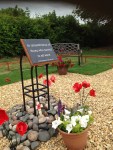
The memorial is flanked by two flags, is neat and well cared for. The runway layout is depicted on the memorial stone and it proudly states the achievements of the 401st. I am led to believe the ‘Wheatsheaf’ pub further along was the haunt of many an American airman and has a ‘401 bar’ with photos and memorabilia. I was not able to visit this  unfortunately and cannot therefore verify this. Definitely one for another day!

DSC_0155

Modern activity at Deenethorpe

Deenethorpe is one of those airfields that has quietly slipped away, the passage of time leaving only simple scars on the landscape. This once busy and prestigious airfield now nothing more than rubble and fields with a memorial to mark the brave actions, the death and the sacrifice made by crews of the United States Army Air Force so long ago.

A BBC news report covered the planting of a time capsule in June 2011, when the widow of Tom Parker (the last of the 401st Bombardment Squadron crew, that flew the B-17 plane “Lady Luck” out of Deenethorpe), kept their promise that whoever was last would bring a collection of tankards back to Deenethorpe with their own personal stories.  The tankards were a gift from the pilot of Lady Luck, Lt Bob Kamper who presented them to the crew at a reunion in 1972. Mr Parker, the last member of the crew, sadly died in March 2011.

May their stories live on forever more.

The BBC news report can be found here.

Deenethorpe falls under Northampton County Council, and like Kings Cliffe in the same area, has been the subject of planning applications. It is proposed that the airfield be removed and all flying activity stopped. A Garden Village will be built on the site, and the area landscaped accordingly. The proposal can be found here.

Deenethorpe was originally visited in Trail 6, ‘American Ghosts‘, from here we go onto an airfield that saw action involving a large numbers of paratroopers, we go to Spanhoe Lodge.

Sources and further reading.

*1 Photo from IWM American Air Museum In Britain.

*2 Photo Roger Freeman Collection, from IWM American Air Museum In Britain. FRE 8079

*3 Photo Roger Freeman Collection, from IWM American Air Museum In Britain. FRE 2218

The 401st BG website contain a vast amount of information about crews, aircraft and missions of the 401st. It can be accessed here.

I highly recommend the book, “The B-17 Flying Fortress Story“, by Roger Freeman, published by Arms and Armour, 1998. Some aspects may have been updated, but the detail is incredible and a worthwhile investment for anyone interested in this area.

A Happy New Year!

As 2015 fades away I would like to take this opportunity to thank each and every one of you who has visited, followed, liked, reblogged, commented and generally supported “Aviation Trails” during the last year. Without you, it would not be the site it is today.

It has certainly grown over the last year and taken on a new dimension. Investment in research material has enabled much longer posts and more personal information to be included, something that I know many people like to see. Not only do ‘we’ as enthusiasts, historical ‘writers’, modellers, relations of veterans etc. preserve our common history, but openly promote and educate others through the writing we do.

I believe it is important to remember what went on, the sacrifice and dedication to freedom, and if I can go a small way to helping that then it has all been worthwhile.

I have been inspired to take up old hobbies, learnt about aspects of military and natural history that I had never heard of, found new places in the world and been a part of a group of people who share the desire to learn, educate and inform others. It has been a wonderful year.

The tally of airfields I have visited is now around 75, double what it was this time last year. I have walked in the footsteps of famous people like Guy Gibson, Glenn Miller and Joe Kennedy, stood where important and famous missions have been planned and executed, trodden the very ground where so many young men and women served their country, many thousands giving the ultimate sacrifice.

It has been a most humbling experience.

So to each and every one of you, a heartfelt thank you, and here’s to a happy, peaceful and rewarding 2016.