Trail 13 continued around the western edges of Norfolk, near to Thetford Forest and the heaths of Breckland. Here, not from Thetford, is an airfield left over from the latter parts of the war. Seeing both RAF and USAAF personnel, it was often boggy and wet, but that didn’t deter those brave young men who fought for freedom.
Now an Army training camp, what’s left is being attacked by another enemy. We return to Southern Norfolk to complete an earlier Trail.
RAF East Wretham (Station 133)
Originally built-in the early part of the Second World War and opened in March 1940, East Wretham was designed as a satellite to RAF Honington with an all grass runway running NE/SW, 2 x T2 hangars, various defence pillboxes, support buildings and a number of blister hangars. At Honington, a newly formed 311 (Czech) Sqn was formed (29th July 1940) flying Wellington ICs, and they utilised East Wretham as a dispersal until August that year, when they permanently moved in. 311 Sqn carried out night bombing duties for the duration of the time they were here, but then in 1942, Wretham’s status changed once more. 311 sqn moved out and East Wretham became a satellite for Mildenhall taking in 115 Sqn on the 8th November, with their Wellington IIIs. The following March (1943) these were replaced with the rarer Lancaster MkIIs and these remained here in the night bomber role, until a further change in August 1943 when 115 sqn moved to Little Snoring and the site passed to American hands to become Station 133.
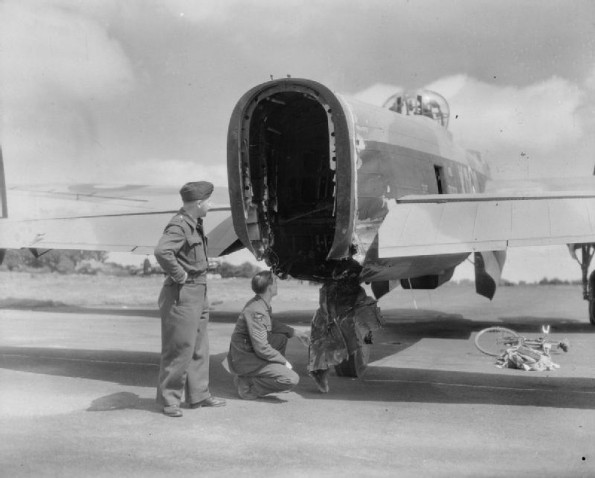
Avro Lancaster B Mk II, DS669 ‘KO-L’, of No. 115 Squadron, was hit by bombs from an aircraft flying above. durinhttps://aviationtrails.wordpress.com/wp-admin/post.php?post=1422&action=editg a raid on Cologne on the night of 28/29 June 1943. The tail gun and gunner were both lost. (Author unknown)

Maj. R. Wetmore, of the 370th FS, in front of P-51B (42-106894) ‘CS-P’. on the shoulders of his ground crew*1.

The old part remains cordoned off.
In November 1945 the USAAF left and no further flying took place at East Wretham . The airfield reverted to 12 Group (RAF) ownership, then in May the following year, it was handed back once more to Bomber Command . Within a month the site was handed over to the Technical Training Command and finally East Wretham became a Polish resettlement camp for those personnel who were unable to return home. When they had all finally be moved on, the majority of the site became what it is today, used by the British Army as part of the massive Stanford Practical Training Area (STANTA ) for manoeuvres and live firing training.

The bombs stores blast walls are still intact – just.
Perhaps the best and by far most accessible examples of East Wretham’s past, is the bomb site which forms part of the East Wretham Heath Nature Heritage Trail. Access is to the south of the site just off the main A1075, Thetford Road. A two-mile walk though Heath land, it takes you right through the original bomb store. An area of natural beauty, famed for its wetland and ancient flints, you can easily find the many blast walls and small fusing buildings still there. Also traceable are the tracks that once took bomb loaded trailers to the airfield across the heath. Many now buried under the acidic soil, their existence evident in exposed patches of bare concrete.

The decay is evident throughout the bomb store.
A small airfield, East Wretham was never considered the most ‘homely’ of sites. Often wet and boggy, it was one of the less well-known and less famous places to be used. But the courage and determination of those who served here both RAF and USAAF, went a long way to helping defeat the tyranny that stood facing us across the small section of water not so far away.
To see the other sites on this Trail, Old Buckenham and Tibbenham, go to Trail 13.
Sources and further reading:
*1 Photo: 359th Fighter Group Association, accessed at http://www.littlefriends.co.uk/
 Aviation Trails
A really interesting post, thank you. On the one hand, it’s a pity that of so many hundreds of airfields, so few have been preserved. On the other hand, with East Wretham, it seems as if it is gradually being reclaimed by peaceful nature.
LikeLiked by 2 people
You are right on both accounts. I think a ‘natural’ takeover is better than being demolished, dug up or built upon so that nothing remains. Thanks for the comment John.
LikeLiked by 1 person
Another fantastic trail report 🙂 Lovely to see the 115 Sqn appearing with their Lanc
LikeLiked by 1 person
I hoped you would like it. A nice link to your work.
LikeLiked by 1 person