The final part of this four part tour takes us to the very edge of North Norfolk’s Heritage coast and the nature reserves of Holkham and Blakeney. Today it resounds with tourists and bird watchers, during the Second World War, it would have been very different.
Our first stop is North Creake, saddling the B1105 road to Wells-Next-the-Sea, it houses a few surprises.
RAF North Creake
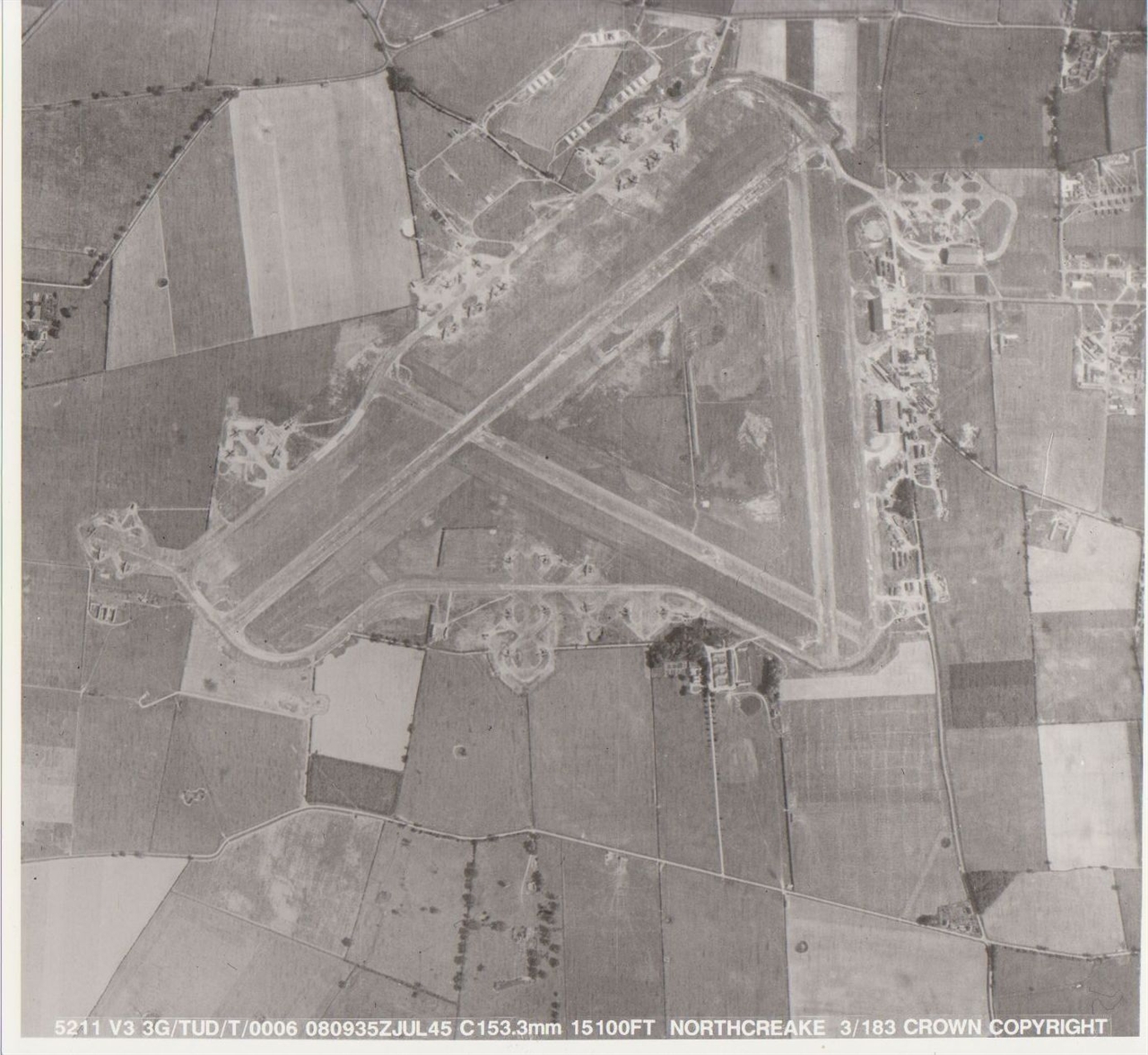
RAF North Creake taken in July 1945, shows a large number of dispersed aircraft around the perimeter.
North Creake, like many of the nearby airfields around this part, was originally a satellite for Docking, which in turn was originally a satellite for Bircham Newton.
Construction commenced on this decoy site in 1940/41, and North Creake, known locally as Egmere from the medieval site it stands on, operated in this role until 1942. With the need for more heavy bomber bases, it was soon decided to upgrade North Creake to a Class A airfield, with accommodation for up to 2,951 male and 411 female staff. Three concrete runways were added, two, 01/19 and 13/31 both 4,314 ft (1,315 m) and the third 04/22 of 5,643 ft (1,720 m). To accommodate the aircraft destined to reside here, 36 loop hardstandings, the majority of which are to the north-west of the site, two T2 hangars and one B1 hangar were also added in. The control tower would be built to the East side of the airfield adjacent to the technical site.

The AML Bombing Teacher nestles in the woods.
Construction was finally completed in 1943, however changes to the structure of Bomber Command, meant that no flying units would operate from here until well into May the following year.
Initially part of 2 Group, North Creake was passed like so many on this tour, to 100 Group, Bomber Command, and would also operate in the Electronic Warfare role. 199 Squadron was the first to arrive. 199 Squadron initially operated Short Stirling bombers, and latterly HP Halifaxes, on radio and radar jamming operations. Flying between 5th June 1944 and 3rd May 1945, they used both ‘Window’ and ‘Mandrel’ on sorties that were frequently combined with standard bombing operations. 199 squadrons ‘C’ flight was broken away from the unit and formed into 171 squadron on September 8th 1944, but carried on this role in support of 199, whose last mission took place on the night of 2nd/3rd May 1945 – in which they flew 17 successful bomber support sorties by Halifaxes in support of an attack against Kiel.
On July 27th, 1945, 171 squadron was disbanded, 199 sqn went 2 days later (being reformed in 1951 with Avro Lincolns, de Havilland Mosquitos, EE Canberras and finally the Vickers Valiant in 1957) and the site was closed to operational flying. It remained as a storage for surplus de Havilland Mosquitos prior to scrapping for a further two years until finally closing in 1947.

One of the remaining T2 Hangars.
Luckily, the causal observer can still see much of this history at North Creake. The road passes directly though the centre of the Technical Site. Nissan huts now used by small industrial units, still thrive, two of the hangers remain, both in use by an agricultural company and minor buildings such the Bomb Teacher and turret trainer can be found lurking between the trees. The main stores, gas clothing and respirator store are also in use, as are a workshop and away to the north-east, the Airman’s huts.

Main stores and Gas clothing huts.
North Creake’s runways and taxiways along with two looped hardstandings, are all but gone, covered in trees or used as pathways for the local farmer, but their location very much evident from satellite photos. Development has begun of yet another solar farm, and these great unsightly panels are gradually taking over yet another of Britain’s wartime airfields.
The one Jewell in the crown of North Creake, has to be the control Tower, purchased by private owners, it has undergone a painstaking transformation being refurbished and turned into a Bed and Breakfast. Modernised inside, it remains one of the better preserved buildings on the site.

North Creake’s Tower now a Bed & Breakfast.
To the south of the site, a memorial has recently been erected by the Airfield’s of Britain Conservation Trust, as a lasting tribute to not only the 17 crews who never returned, but to all those who served at RAF North Creake during the latter days of World War Two.
North Creake is certainly a gem for those wishing to see airfield architecture first hand, and if you desire, the chance to stay inside a tower that would have played a big part in Britain’s attack on Nazi Germany.
Leave North Creake heading north toward the coast, and then turn east. A few miles away lies our next and final stop, RAF Langham.
Links
Details of the North Creake Control Tower Bed & Breakfast can be found here.
 Aviation Trails
Love the airfield names “North Creake” and “Little Snoring.” — Both in north Norfolk. Only English would name airfields or villages those. Saw their names on a map of RAF Airfields of WW2. Liked reading the nostalgic true stories. Unfortunately the photos wouldn’t open, except the banner one each. Now North Creake and Little Snoring seem like airfield homes. Yes I watched “The Shepherd” a few days ago.
LikeLiked by 1 person
They are rather quaint aren’t they and yes, only the British would do such a thing. If you Google odd English villages names I’m sure you’ll find many more even odder!
LikeLike
Great piece about RAF North Creake… 🙂
As well as running the Control Tower as a Bed & Breakfast we also open the tower now and then for building tours with a bit of the history of the airfield (http://controltowerstays.com/open-days.html)
We plan to write the history one day… but first we must finish the works to the tower and surrounding buildings. We have an active Facebook page (https://www.facebook.com/The-Control-Tower-old-North-Creake-Airfield-285585778171932/) and a mailing list if anyone would like to go on drop us a line to mail@controltowerstays.com
Maybe we’ll see some of you here one day
Claire & Nigel
LikeLiked by 1 person
Thank you both. Certainly from what I saw you are doing a marvellous job and I can only say that it’s great to see these old buildings being preserved. Thank you for the links and information, the tours certainly sound interesting and I shall look out form them in the future. Hope to see you one day. Good luck with the venture! Andy
LikeLike
Another really interesting, thanks very much. Back in the day, as a birdwatcher, I drove along that A149 coast road a few times. North Norfolk is a really beautiful place.
LikeLiked by 1 person
Thank you. It certainly is and a bird watchers paradise I believe.
LikeLike