‘In the Mood’ for aviation nostalgia?

Taking advantage of the winter sun and nearby location, I decided to take a short visit to one of the earlier trails and see how things had changed. Being a different time of year too, perhaps the buildings I saw would now be less obscured. I also thought that the initial trails were lacking and needed a little ‘historical substance’.

Whilst not wanting to lose sight of the idea behind the blog, I felt a little extra would not go amiss. Hearing about a memorial that I had missed earlier, I braved the late December air, donned coat, hat and scarf and set off to Kings Cliffe, in the top corner of Northamptonshire – land of Fighter squadrons and the last hangar concert performed by Major Glenn Miller.

RAF Kings Cliffe (Station 367)

(Revisited and updated December 2014)

DSC_0169

The Memorial at Kings Cliffe.

Unlike the other airfields in the tour, Kings Cliffe was a fighter airfield. Pass through the village from the south, out the other side, under the odd twin-arched bridge and then right. A few hundred yards along and the airfield is now on your right hand side. The memorial is here, flanked by the two flags. It is a more elaborate memorial than some, being made with the wing of a Spitfire on one side and the wing of a Mustang on the other. Various squadron badges are etched into the stone and as the weather takes it’s toll, these are gradually disappearing.

DSC_0197

Protected aircraft pen, with ‘dual skin’ defences on three sides. A number of these litter the site.

Over its life, Kings Cliffe would have a number of fighter units grace it skies. Built in 1943, it would receive its first squadron late that same year when P-39 Airacobras of Duxford’s 347th FS (350th FG) were temporarily based here. A short spell they would soon leave and be replaced with another short-term unit.

The following January, the 347th left and three squadrons: the 61st (code HV), 62nd (code LM) and the 63rd (code UN) of the 56th FG arrived from the U.S. This group fell under the command of the 67th Fighter Wing, Eighth Air Force. Redesignated the 56th FG in the previous May, they were initially given P-47s and continued to train at Kings Cliffe for fighter operations until moving on the 4th/6th April 1943 to Horsham St Faith, Norfolk. A few days later on 13th April 1943, they undertook their first operational sortie. Over the next two years the 56th FG would become famous for the highest number of destroyed aircraft of any fighter unit of the entire Eighth Airforce. A remarkable feat.

Littlefriends.co.uk

Pilots of the 77th FS, at Kings Cliffe 1944-45*1

After the 56th left Kings Cliffe, three more squadrons arrived. In August that year, the 20th FG arrived with their P-38 Lightnings. The 55th (code KI), 77th (code LC) and the 79th (code MC), would fall under the umbrella of the 67th Fighter Wing, Eighth Airforce.

After a spell of renaming, aircraft changes and training, their arrival at Kings Cliffe would see a period of stability for the 20th. Initial operations started in December that year, and their primary role would be to escort bombers over Europe, a role it maintained until the cessation of conflict. Targets of opportunity were often found whilst on these missions, but toward the end of the war, with fighter cover becoming less of an issue, dive bombing and ground attack missions became more common place. Their black and white chequered markings became feared by airfields, barracks and in particular trains as they became known as the “Loco Group” for their high number of locomotive attacks.

Oakington Pillbox Kings Cliffe Dec 2014

Oakington Pillbox, found in pairs, they offer a 360 degree field of fire.

On April 8th 1944, the 20th attacked an airfield in Germany, action for which they received a Distinguished Unit Citation (DUC). They would later take part in the Normandy invasion, Operation Market Garden, and air cover in the Battle of Bulge. In July 1944 they converted to P-51s and continued to escort bombers and search out targets of opportunity until the war closed. In the following October 1945, they returned to the U.S. and Kings Cliffe was returned to RAF ownership. The RAF would use it as a storage depot until selling it off in 1959. Its runways were dug up for hardcore, the buildings demolished and the site finally returned to agriculture.

Kings Cliffe December 2014 Draincover

Drainage covers and pipes adorn the remains of the runway.

Whilst standing at the memorial, it is difficult to imagine any of the activity that occurred here all those years ago. However, behind the memorial you can see a number of brick defence buildings enshrouded in trees and bushes. Move along the road to your right and there is the main gate. Stating that it is an airfield, it doesn’t encourage entrance. However, walk or drive a little further and there is a bridal way that allows access to the site. Walking along around the edge of the airfield, you can see hidden amongst the thorn bushes  an Oakington Pill box. Found in pairs and common in this area, they offer a 360 degree view of the site. The second of the pair is  short distance away in the middle of the field and more visible to the viewer. Also round here are three protected dispersal pens. Each pen has a double skin, in other words, an outside loop holed wall for firing through and an inner wall to protect air and ground crews in the event of an attack. There are a handful of other ancillary buildings here, all of which can be accessed with careful treading. A considerable number of these exist close to the road and path, so extensive travelling or trespass is not required for the more ‘informal’ investigation.

DSC_0188

Inside the Shelter.

Walking further along the path, you pass a large clump of trees heading of in an easterly direction. These mark the line of the east-west runway. Whilst the runway has gone, evidence of its existence can be found. A drainage channel, numerous pieces of drainage material and grates can be found amongst the remains of hardcore.

The path continues in a southerly direction away from the main part of the airfield, and a better option may be to return to the car and drive along to a different part of the site.

If you return through Kings Cliffe, bear left and through the small but gorgeous village of Apethorpe. Continue on and you’ll see a footpath that goes through the woods. Park here and walk through the woods. A couple of miles in and you come across a large open space, to your left is a distinguished memorial to Glenn Miller.

Glenn Miller Memorial RAF Kings Cliffe Dec 2014

Memorial to Glenn Miller’s final hangar concert, 3rd October 1944.

The memorial is located on the site of the original T2 hangar, quite a distance away from the main airfield. It was here that Miller performed his final hangar concert on October 3rd 1944. Standing here in the wintry air listening to ‘In the Mood’, is a surreal experience. To think that, on this spot 70 years ago, this very tune was performed by Miller himself; whilst young couples jitterbugged the evening away – a brief respite from the wartime tragedies that dominated their daily lives.

Leaving here, back to the track, you come across a footpath that takes you north, toward the main airfield before veering off and away to the west.

This path provides what is probably the nearest access point to the tower, as it crosses the track that joins the perimeter near to the towers location. The control tower still stands, but access from the path is over private land and should be undertaken with the land owner’s permission.

A final car trip back to the north side of the airfield reveals evidence of the accommodation blocks. The cinema, Gymnasium and chapel along with some other communal buildings still stand and in use by local timber companies. Well preserved, they are easily accessible and offer a good view to anyone aiming to find evidence of Kings Cliff’s history.

Kings Cliffe December 2014 Chapel with gym

Gymnasium and Chapel now used by a timber company.

Like many sites of it’s age, the majority of Kings Cliffe’s buildings are overgrown, indeed entering them you can see how the roofs have become detached in many cases, and mature trees now the only inhabitants where personnel once stood.

The main part of the airfield is agriculture, and it can be seen from further back, why this site was chosen as the views across the landscape toward Peterborough and the south are stunning. A remarkable place, it offers good evidence, nostalgia and beautiful walks into the bargain.

Overgrown buildings

Overgrown buildings

Kings Cliffe concludes this tour, however, if you return back along the road to the village of Kings Cliffe, turn right away from the village, you will eventually find yourself sitting opposite one of the crash exits of RAF Wittering, the main station to which Kings Cliffe was built as a satellite. Also along here, is a remnant of RAF Collyweston, an airfield absorbed into RAF Wittering at the end of the war when it expanded ready for the V – force bomber aircraft and later the Harriers. Now closed to flying due to government cutbacks, it houses an army detachment and a small RAF detachment for maintenance duties only.

Much of the evidence from the American participation in the Air War of the Second World War has now disappeared, being swallowed up by natures determination to regain what was originally hers. Agriculture and small businesses have clung on to the remainder, leaving little to see. In some ways, and I touched on this earlier, the fact that peace has now taken over what were bustling camps of 3000+ personnel, the roar of four engined bombers laden with high explosives or troop carriers taking scared young men to the killing fields of Europe, is a reflection on their bravery and dedication. These areas are simply peaceful now because of the men that served, lived and died here and whilst they are now gone, maybe their ghosts remain.

Kings Cliffe originally featured in Trail 6 ‘American Ghosts’.

*1 photo by Robert Derenbacker from ‘Little friends’ website http://www.littlefriends.co.uk

The year comes to a close.

It’s been a little quiet on the trials, for me, school work has taken over and it’s been difficult to get out and about. But as the year draws to an end, we can see progress has definitely been made and the blog has taken many steps forward in its development.

Each completed trail reveals many little anecdotes that deserve to be researched further and shared. Personal stories of heroism, dramatic tales of sacrifice and tragedy, each one a story of one individual’s life and death.

There are many people out there who share our interests. Before visiting these wonderful places, I like to see what others have seen before. Their records provide a great reference as to the extent of decay and the loss of these historic sites. It never fails to amaze, how quickly not only developers take over, but Mother Nature herself. A powerful force, she very quickly sows her seeds and before long brambles, bushes and trees reduce these old buildings to rubble.

Many of us believe that the historical impact of these airfields should be much better preserved. I for one, appreciate the need for housing and cost of maintenance etc but there must be a compromise so everybody ‘wins’. One suggestion is that with each development contract there could be a clause to restore, renovate and preserve a small element of each site so that generations to come can witness some small part of what happened in these amazingly emotive places. Perhaps our planners could consider all options before the last remaining sites disappear for ever.

There are currently a number of projects around the UK who are striving to preserve remnants of these sites, some with small successes, but it is all an uphill struggle. It is hoped that by raising awareness and sharing the trails, we can do our small part to help keep the memories of those brave young men and women who fought a war, some a very long way from home, very much alive.

Here’s to 2015, more trails and maybe some revisits, thank you to all those who have read, commented and contributed to the blog, it’s great to have you onboard and to share our common thoughts. We look forward to reaching out to many more in the coming months.

I would like to give a big personal special thank you to Marcella who has helped with much of the research, I know it has become a very big part of her life too and together we have learnt so much about those days back in the 1940s.

A merry Christmas and a happy and safe new year to you all.

Andy and Marcella.

A Tuskegee Airmen from St. Louis, MO: Captain Hugh J. White

It was 35 years ago today that the life of a brave African-American man from St. Louis, Missouri, (MO) ended. His name was Captain Hugh J. White, and he was a Tuskegee Airmen.

Riviera Beach high schoolers meet the United States' first black military aviators, the Tuskegee Airmen photo

Tuskegee Airmen Charles Hill, second from left, with fellow pilots (l-r) Hugh White, Lincoln Hudson and Carl Ellis, taken in 1944 in Alabama. Courtesy of Charles Hill.


You might recognise St. Louis, MO and places like nearby Ferguson, MO from the news as of late, but not for the great accomplishments of its citizens, rather for the seemingly never-ending division among between people of different races. The actual Ferguson case aside (because I do not know enough about it to comment intelligently, nor do I want this post to draw any more attention to a topic that has had more than its share), It is my goal, that we, as a community, as members of the human race, spend more time considering the things we share in common and discussing the positive contributions that are made by all people. That is not to diminish the importance of such issues of racial division, because they are of the utmost importance. It is simply, that I would like to see the focus move in a different direction.

On December 14th, 1979, Captain Hugh J. White, passed away. Yes, it was 35 years ago this very day. An anniversary worth noting I believe. Captain White was a veteran of the United States Army Air Corp and a famous Tuskegee Airmen, who began his decorated career as an Aviation Cadet.

Captain White was born on August 24th, 1922 in St. Louis, MO. As he did with nearly everything in his life, he approached his high school years with nothing short of expecting complete excellence from his efforts. As a young teenager at Charles Sumner High School, he did just that; he excelled. He was voted by his peers to be president of his class and earned top grades and graduated as a member of the National Honour Society.

His plans, like many young men growing up in wartime, changed quite suddenly. His initial plans were to attend Stowe Teachers College and pursue a worthwhile career. However, as events in Europe grew more dire, it became apparent that every able-bodied young man must rise to challenge and answer the imminent call of duty to country and homeland. It was in January 1943 that he volunteered for the United States Army Air Corp. Not long after, Captain White was sent to Tuskegee, Alabama for his initiation and training.

Captain White graduated as part of Class 44-F, and because of his own high standards and insistence upon personal excellence, he graduated at the top of his class. He was then sent to the European Theater of Operations to participate in the war in Italy. He became a pilot assigned to the 99th Pursuit Squadron of the 322nd Fighter Group, and in the course of his dedicated service, earned 190 combat hours and flew 35 combat missions.

Photograph shows, first row: 1. Hugh J. White, St. Louis, MO, 44-F; 2. Col. Benjamin O. Davis, Commanding Officer, 332nd Fighter Group, Class 42-C; 2. Conrad A. Johnson, New York, NY, 44-G; 4. Thurston L. Gaines, Freeport, NY, 44-G; 5. Robert W. Williams, Ottumwa, IA, 44-E; 6. Lewis J. Lynch, Columbus, OH, 44-F; 7. William T. Matison, Conway, AR, 42-I. Second row: 1. Rual W. Bell, Portland, OR, 44-D; 2. Elbert N. Merriweather, Jr. Brooklyn, NY, 44-G; 3. John H. Lyles, Chicago, IL, 44-G; Leland H. Pennington, Rochester, NY, 44-G; 5. unidentified; 6. unidentified; 7. James H. Fischer, Stoughton, MA, 44-G; 8. George Arnold Lynch, Valley Stream, NY, 44-F; 9. Rupert C. Johnson, Los Angeles, CA, 44-F. Image and caption credit: Library of Congress, Prints & Photographs Division, Toni Frissell Collection.


On April 23rd, 1945, whilst flying his 35th mission, Captain White’s P-51 was shot down by anti-aircraft fire whilst escorting B-24s on a bombing mission over Italy. He survived but was captured and became a prisoner of war. Though no doubt both trying and difficult for him, he survived his ordeal as a POW. Thankfully, while White was in captivity, the Second World War in Europe finally drew to its conclusion and hostilities ceased. White was soon released and repatriated with his unit.

Captain White received an honourable discharge and eventually returned to his beloved homeland safe and sound, and he went home to St. Louis, MO. Never one to be without a goal, he applied to and was accepted to the Cleveland Marshall Law School (in Cleveland, Ohio). He graduated from law school, passed the Missouri bar exam, and his practice specialised in criminal law.

Not unlike high school, Captain White was again elected by his peers, though this time to the Missouri Legislature where he served as a State Representative. He was first elected in 1961, and in 1963, his constituents re-elected him to be their State Representative once again,

Captain White was a key figure in the organisation of the St. Louis Chapter of the Tuskegee Airmen before his death in 1979.

scan painting Hugh J. White Tuskegee Airmen P51 Pilot St. Louis

For his dedication, determination and bravery, and for action against the enemy, Captain White was awarded the Purple Heart. Captain White and the numerous other Tuskegee Airmen, fought alongside their fellow American airmen, for the rights and freedoms that all of us enjoy today.

On the 35th anniversary of his death, we owe a great deal of gratitude, not only to Captain White and his compatriots, but to all who fought in World War II.

–  By Marcella Beaudreau


What the Luftwaffe failed to do, the local council have finally managed.

Many of Britain’s airfields have hung on desperately to a small corner of history. Hawkinge is sadly one of those that has been buried deep beneath housing, schools and shops. Sadly, one of England’s most historic airfields, has finally been defeated not by Goring’s Luftwaffe, but by local planners.

Hawkinge was at the forefront of the Battle of Britain, it was repeatedly attacked by the bombers of the Luftwaffe. Because of its location, just minutes from France, crews would often have little warning and would have to take to the sky unprepared. Many returning aircraft would use its runways as a safe haven returning battle damaged and weary; Hawkinge fire crews were some of the busiest Britain was to have. It was used as a transport depot in the First World War, became a mecca for international pilots, saw some of the first ‘drones’ and was used in the filming of the 1969 film ‘The Battle of Britain’.

Today a small museum, utilises what’s left of the original buildings whilst housing creeps like poison ivy, ever further across the airfield.

The nearby cemetery is home to not only RAF pilots but also fallen Luftwaffe crews, ironically remaining in the land they tried to take all those years ago.

As part of a second aviation trail around historic Kent, Hawkinge is a must for any follower of history, aviation or the Battle Of Britain.

See the full story and Kent’s second trail here.
lady cropped 2 B&W


Eisenhower stopped off at Lashenden

It was during this time, on July 4th 1944, that General Eisenhower stopped off at Lashenden following one of his many flights over the German lines in Normandy. His pilot, Brig. Gen. Elwood R. Quesada, veteran of 90 sorties, was berated by his superiors for such a ‘foolish’ act. In response he said, “When a five-star general says ‘Go,’ you go!”

Lashenden, also known as Headcorn, was an advanced landing ground, built initially for the RAF, it was taken over by the US Ninth Airforce who used to to fly P-51s and P-47s out over France.

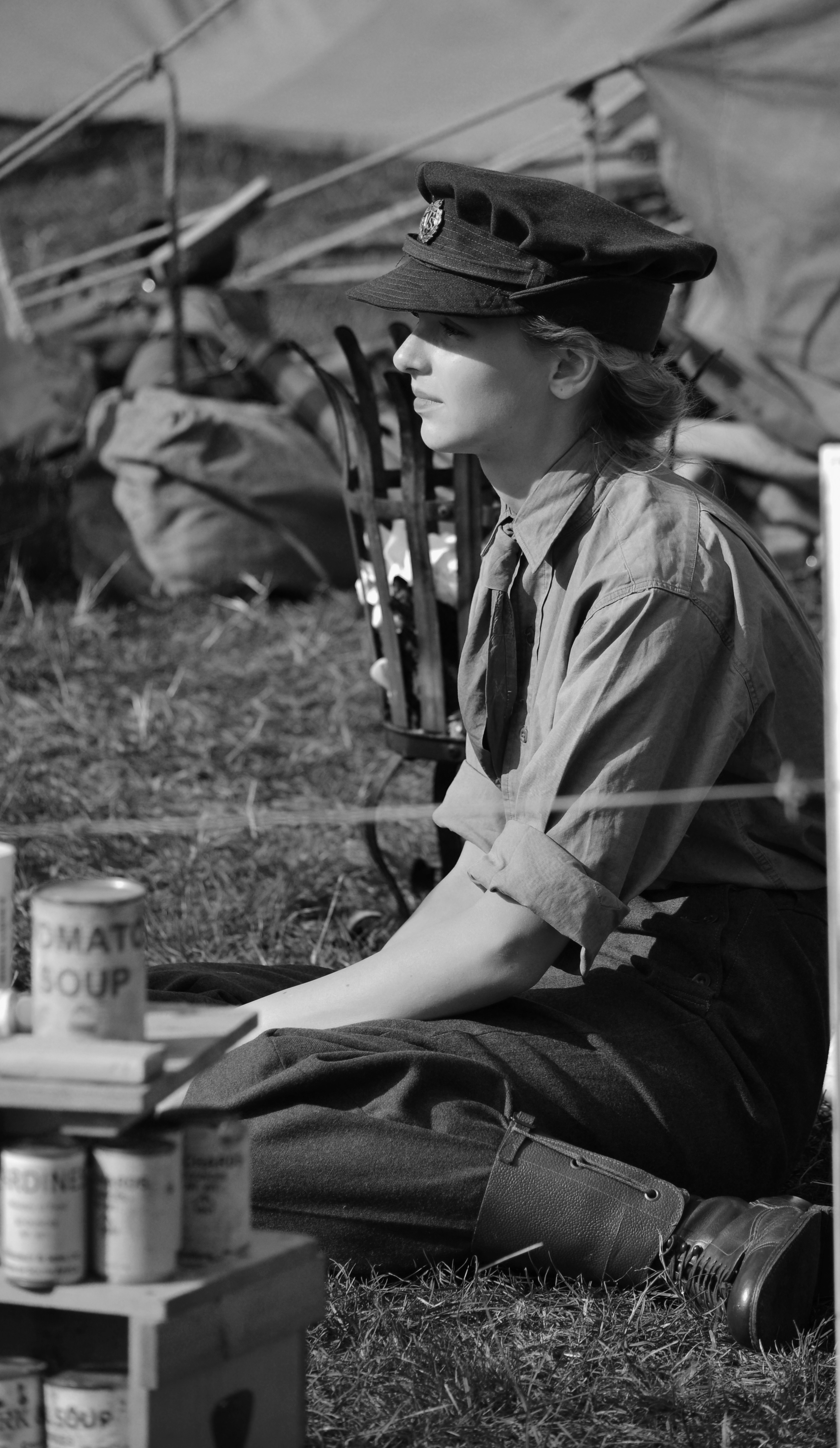
Today it is a thriving airfield, whose annual reenactments bring back the nostalgia of 1940s Britain. Find out more about Lashenden’s history and other airfields in Kent. Click on this link.

lady cropped 2 B&W

1940s Britain is reenacted on the Former Lashenden Advanced Landing Ground used by the Ninth Air Force.