A B26 – that holds a remarkable record…

B-26B of the 449th BS (322ndBG)  – ‘Flak Bait‘  – went on to complete a total of 207 missions; more than any other American aircraft during World War II, a record only surpassed by a DH Mosquito of the RAF. This aircraft returned to United States after the war and is now housed in the Smithsonion National Air and Space Museum as a reminder and memorial.

Station 468, Bury St Edmunds (RAF Rougham) is now a museum and small active airfield that pays homage to the crews of the USAAF. Visit Trail 16 and see what remains.

Photo by MSGT Bernard Leroy Oligschlaeger (1921-1976) USAAF – Gunner/Radioman in 394th BG/586th BS

Cold and unhomely, it was home to 2000 personnel

The admin blocks were designed to accommodate 1,845 men and 250 women, in a large area to the south of the airfield. Tuddenham had a total of 12 administration and technical areas spread across the entire site. Hurriedly built, the accommodation blocks were unheated, cold and un-homely“.

RAF Tuddenham, located in the western side of Suffolk, close by to RAF Mildenhall, one of the USAF’s busiest bases, was home to Stirlings and Lancasters of RAF Bomber command. They suffered heavy losses in the bombing campaign over europe.

Visit Tuddenham today in Trail 16.

DSC_0002

Tuddenham village sign depicts a Lancaster of 90 Squadron RAF flying overhead.

The 1000th Douglas built B-17 served at RAF Glatton

The 1000th B-17 constructed at the Douglas Long Beach Plant, USA, number 42-38113, went to serve with the 457th BG at RAF Glatton. Named ‘Rene III’ by its crew, it served its last mission, No. 214, on March 21st 1945 over Hopsten, when it was hit by flak, and crashed. Luckily all but one of the crew, Aircraft Engineer, Sgt William Wagner, evaded capture. Glatton has now been updated and added to ‘American Ghosts‘.

A small active airfield, it was once a thriving community, housing a vast number of American crews and support staff. All that remains is a water tower, sections of the runway and a superbly crafted memorial stone. But, hidden away in the local church, someone is watching out for missing comrades.

Col Luper with ‘Rene III’ the 1000th Douglas built B17 at Glatton, England.

For the Fallen – Laurence Binyon (1869-1943)

To all those who went before, Laurence Binyon’s 1914 poem is widely used in remembrance services across the world. It was published 100 years ago today. http://wp.me/P4xjD9-8u

For the Fallen

With proud thanksgiving, a mother for her children,
England mourns for her dead across the sea.
Flesh of her flesh they were, spirit of her spirit,
Fallen in the cause of the free.

Solemn the drums thrill: Death August and royal
Sings sorrow up into immortal spheres.
There is music in the midst of desolation
And a glory that shines upon our tears.

They went with songs to the battle, they were young,
Straight of limb, true of eye, steady and aglow.
They were staunch to the end against odds uncounted,
They fell with their faces to the foe.

They shall grow not old, as we that are left grow old:
Age shall not weary them, nor the years condemn.
At the going down of the sun and in the morning
We will remember them.

They mingle not with their laughing comrades again;
They sit no more at familiar tables of home;
They have no lot in our labour of the day-time;
They sleep beyond England’s foam.

But where our desires are and our hopes profound,
Felt as a well-spring that is hidden from sight,
To the innermost heart of their own land they are known
As the stars are known to the Night;

As the stars that shall be bright when we are dust,
Moving in marches upon the heavenly plain,
As the stars that are starry in the time of our darkness,
To the end, to the end, they remain.

(Published in The Times newspaper, 21st September 1914).

DSC_0169

For the Fallen – Laurence Binyon (1869-1943)

A Heroine Meets an Ungainly Ending.

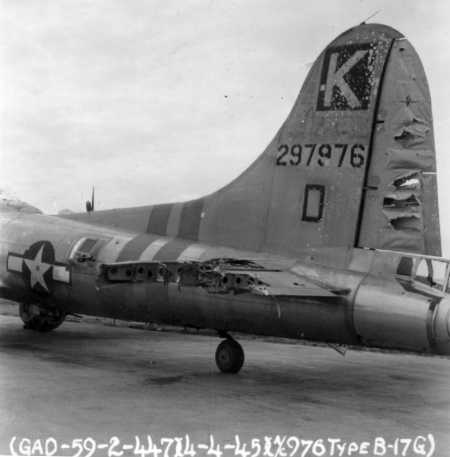
Originally designated ‘Louie the Creep’, B-17 42-97976 was repaired and  returned to Rattlesden as ‘Bit o’ Lace’. She went on to complete 82 missions in total before being returned via Bradley Field, Boston, to Kingman AAB for storage. Later she met an ungainly ending being stripped and scrapped on 9th November 1945.

42-97976_g

B-17 42-97976 ‘Bit o’ Lace’ after the attack on Kiel, 4th April 1945 (author unknown)

‘Bit o’ Lace’ earned notoriety whilst serving from RAF Rattlesden in Suffolk. She is famous for several special reasons one of which is for completing a mission with only half a tail.

What’s the other?